If you take a GLP-1 medication and a procedure is on your calendar, GLP-1 before surgery is one of the most important things to plan for. Anesthesia teams now routinely ask about these medications, and for good reason: they change how your digestive system behaves, and that matters when you are about to be sedated. The good news is that this is a manageable conversation, not a reason for alarm. It simply needs to happen early, with the right people, and with the right details.
This guide explains why anesthesiologists care, how major medical societies have approached the question, what a new large study does and does not tell us, and exactly what to share with your surgical team. It is educational and does not replace advice from your own providers. Decisions about your care should be made together by your surgeon, your anesthesia team, and the clinician who prescribes your medication.
Why GLP-1 before surgery is a safety conversation, not a side note
Anesthesia is designed to be safe, and a big part of that safety comes from preparation. Before a procedure that involves sedation or general anesthesia, you are asked to stop eating and drinking for a set period. The goal is an empty stomach. Under anesthesia, the reflexes that normally keep stomach contents out of your lungs are relaxed, so anything left in the stomach could travel the wrong way. Clinicians call this pulmonary aspiration. It is uncommon, but it can be serious, which is why fasting rules exist in the first place.
GLP-1 medications such as semaglutide and tirzepatide are designed to work in part by slowing how quickly the stomach empties. That is one reason people feel full sooner and stay satisfied longer between meals. It is also the reason anesthesia teams want to know about them. If the stomach empties more slowly than usual, standard fasting times may not always leave it as empty as expected.
That does not mean GLP-1 treatment and surgery cannot go together. It means your care team needs accurate information so it can plan around your medication. A patient who mentions their medication, dose, and timing at the pre-op stage gives the team room to adjust. A patient who forgets to mention it leaves the team guessing.
What slowed stomach emptying means in the operating room
Researchers have been studying this question closely. A UTHealth Houston study published in JAMA Surgery used stomach ultrasound to check for leftover stomach contents in more than 120 patients scheduled for elective procedures. The researchers reported that more than half of the patients taking a GLP-1 medication still had significant stomach contents even though they followed their fasting instructions, a rate significantly higher than in patients who were not taking one. The team pointed to options such as changing when the medication is taken, extending fasting, or rescheduling an elective procedure when needed.
It helps to keep that finding in perspective. It was a relatively small study, and an ultrasound finding does not tell us how often aspiration actually happens. What it does show is why anesthesiologists do not treat these medications as a footnote. They have seen a measurable effect and want to plan for it.
How much this matters for any one person can depend on several things, including how long you have been on the medication, where you are in your dose adjustment schedule, and whether you are having stomach-related side effects such as nausea, vomiting, bloating, or reflux. Those are exactly the details your anesthesia team will ask about. If you want to understand what those side effects look like, our posts on common tirzepatide side effects and what to expect on semaglutide cover them in detail.
How medical societies approach GLP-1 medication around surgery
Guidance on this topic has changed over time, which is part of why patients get mixed messages. In June 2023, the American Society of Anesthesiologists released consensus-based guidance that included considering a pause in GLP-1 medication before elective surgery, largely out of aspiration concerns. The guidance itself acknowledged that the evidence behind it was limited, as this published commentary explains.
In October 2024, five organizations released a joint document: the American Society for Metabolic and Bariatric Surgery, the American Society of Anesthesiologists, the American Gastroenterological Association, the International Society of Perioperative Care of Patients with Obesity, and the Society of American Gastrointestinal and Endoscopic Surgeons. Their multisociety clinical practice guidance says that using a GLP-1 medication around a procedure should be based on shared decision-making between the patient, the procedural and anesthesia teams, and the prescriber. The goal is to balance the reason you take the medication against your individual risk.
According to the American Gastroenterological Association’s summary, the guidance also advises that most patients may be able to continue their medication as prescribed before elective surgery and GI endoscopy. Patients at higher risk for significant stomach-related side effects may be asked to follow a liquid diet for 24 hours before the procedure, with the anesthesia plan adjusted to match. The societies describe the document as guidance rather than a formal evidence-based guideline.
Notice what that guidance does not say. It does not say everyone should continue their medication, and it does not say everyone should stop. It says the right answer depends on you. That is why a blanket rule you read online, including in this article, cannot replace a conversation with the people involved in your care.
What the new surgery-outcomes research does and does not show
You may have seen headlines in October 2026 about a large study suggesting that GLP-1 users had fewer complications after surgery. Here is what was actually reported. According to the American Society of Anesthesiologists, researchers from McGovern Medical School at UTHealth Houston presented results at the ANESTHESIOLOGY 2026 annual meeting. They analyzed health records from 2,028,601 adults in the United States who had elective surgeries lasting longer than an hour and stayed in the hospital at least 24 hours between 2016 and 2024. About 7 percent of those patients, or 145,610 people, were taking GLP-1 medications.
After matching GLP-1 users with similar patients who were not taking them, GLP-1 use was associated with 11 percent lower odds of major cardiovascular complications and 8 percent lower odds of postoperative infections. The cardiovascular category included heart attack, heart injury, stroke, and death, and the infection category included surgical site infections, urinary tract infections, pneumonia, and sepsis.
Those are interesting findings from a very large dataset. Several limits matter, though:
- It is observational. The researchers looked back at existing records rather than assigning patients at random. The study team states plainly that it cannot prove cause and effect, and that other factors may have contributed to the lower complication rates.
- It was presented at a meeting. Results shared at medical conferences are generally considered preliminary until they are peer reviewed and published, and the release notes that presented data may be updated from the original abstract.
- It does not support starting a medication to prepare for surgery. The study looked at people who were already taking GLP-1 medications. It does not show that starting one lowers surgical risk.
- It does not settle the stomach-emptying question. The lead author said more research is needed to understand whether the medications themselves drive the differences and how best to manage them before and after surgery.
The takeaway is that researchers have good reason to keep studying how these medications behave around surgery. The findings are not a promise that taking a GLP-1 medication will protect you in the operating room, and they are not a reason to change your plan without talking to your care team. If you are curious about how these medications may relate to the body’s inflammatory response more broadly, our overview of weight loss medications and immune system health is a helpful companion read.
What to tell your surgical and anesthesia teams
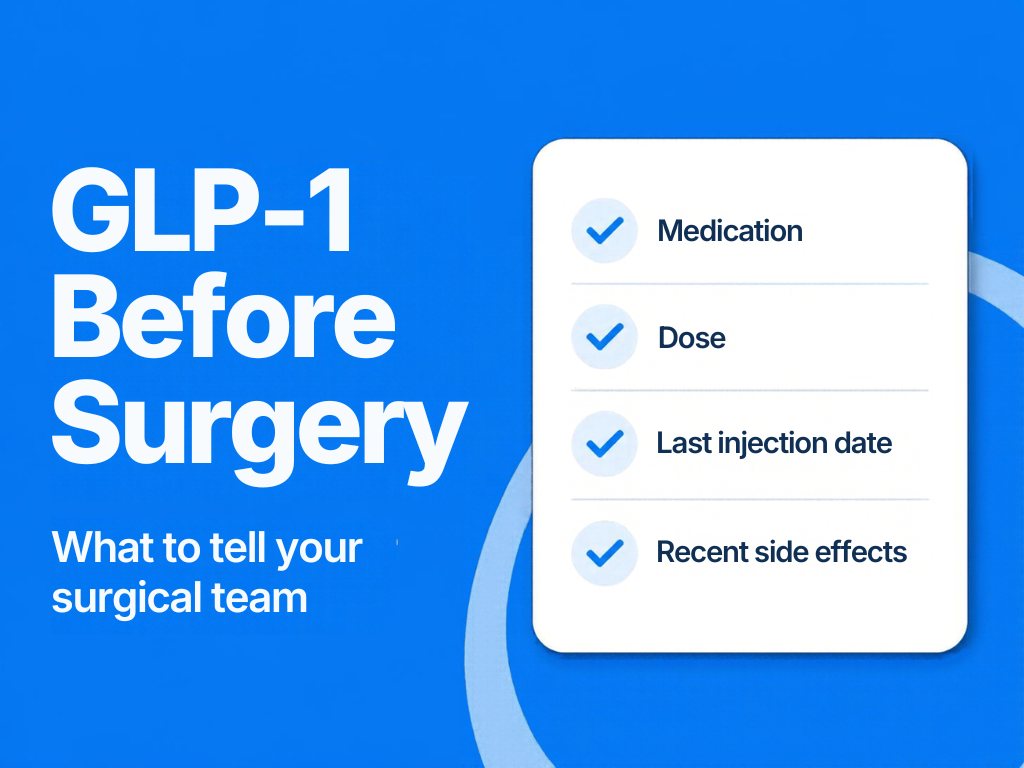
When you schedule a procedure, bring up your medication right away rather than waiting for the pre-op call. These are the details to share:
- Which medication you take, for example semaglutide or tirzepatide.
- Your current dose and how often you inject it.
- The date and time of your most recent injection.
- Whether your dose has increased recently or is scheduled to change before your procedure.
- Any recent nausea, vomiting, bloating, constipation, reflux, or feeling unusually full after small amounts of food.
- Whether you take any medication for diabetes, since changes to those may be part of the plan.
- Everything else you take, including over-the-counter products and supplements.
Many people assume the surgical team already knows because it is in their records. Records can be incomplete, especially when a medication was prescribed by a different provider, such as an online practice. Saying it out loud takes about thirty seconds and removes the guesswork.
If you realize later that you did not mention it, tell the team as soon as you remember, even on the day of your procedure. It is never too late to speak up, and no one will be upset that you did.
Questions worth asking before your procedure
Your appointment is also your chance to get clear, written instructions. Consider asking:
- Should I continue my medication as scheduled, or adjust the timing of my next injection?
- Do you want me to follow a liquid diet or a longer fasting period before the procedure?
- Will my anesthesia plan change because I take a GLP-1 medication?
- Might you check my stomach with an ultrasound before the procedure begins?
- When should I restart my injections afterward, and at what dose?
- Who should I contact if I develop nausea or vomiting in the days before my procedure?
Write down the answers, and ask for the instructions in writing if you can. Pre-op instructions are easy to forget, especially when you are nervous.
Why you should not stop or change your medication on your own
It can be tempting to take matters into your own hands, either by skipping an injection “to be safe” or by continuing as usual and saying nothing. Both approaches carry risk. Stopping without a plan can bring back appetite and other effects, which we explain in our post on what happens when you stop semaglutide or tirzepatide. For people who use these medications to help manage blood sugar, changing the plan can also affect glucose control around surgery. The societies’ guidance specifically describes weighing your metabolic need for the medication against the procedural risk, and that is a judgment for your care team to make with you.
The same applies to fasting. Follow the written instructions you are given, and do not add or drop restrictions yourself. Extra fasting without guidance can leave you dehydrated or lightheaded, while ignoring the instructions can create the very problem the fasting rules are meant to prevent.
The safest path is a three-way conversation among you, your surgical and anesthesia teams, and your prescriber. If you are a Medica patient, let your Medica provider know as soon as a procedure is scheduled, and share any written instructions from the surgical team so everyone is working from the same plan.
After your procedure: getting back on track
Recovery brings its own considerations. Appetite often dips after anesthesia and surgery, and nausea from anesthesia or pain medication can overlap with the stomach-related effects of a GLP-1 medication. Ask your team when you can restart your injections and whether any change to your dose is needed before you do.
Staying hydrated matters during recovery, and our guide to how much water to drink on GLP-1 treatment offers practical targets. Healing also depends on getting enough nutrition, so if you are eating very little, mention it at your follow-up. Contact your surgical team promptly if you have persistent vomiting, cannot keep fluids down, or notice anything that feels wrong.
If you are still weighing whether surgery is the right path, you may find it useful to read about comparing lifestyle changes, medication, and surgery, or how medical weight loss fits into the surgery conversation.
How Medica Weight Loss fits into the picture
At Medica Weight Loss, treatment starts with an online consultation. A licensed provider reviews your health history, current medications, and goals to decide whether GLP-1 treatment may be appropriate for you. If you are already in treatment, your Medica provider is the right person to loop in before any procedure. If you are considering treatment and have surgery or an endoscopy coming up, mention it during your consultation so your provider can factor it in from the start.
You can learn more about semaglutide treatment through Medica and tirzepatide treatment through Medica, or walk through our step-by-step guide to getting started. Whether treatment is right for you is a decision made with a licensed provider, based on your individual health.
Frequently asked questions
Do I have to stop my GLP-1 medication before surgery?
Not necessarily. The 2024 multisociety guidance says most patients may be able to continue their medication before elective surgery, but the decision is individualized and made together by you, your procedural and anesthesia teams, and your prescriber. Do not stop or change your medication on your own.
Why do anesthesiologists care about GLP-1 medication?
These medications are designed to slow stomach emptying. If food or liquid remains in the stomach during anesthesia, there is a risk it could enter the lungs, which is called aspiration. Knowing about your medication helps the team plan for that risk.
Will I need to fast longer or follow a liquid diet?
Possibly. The 2024 guidance suggests that patients at higher risk for significant stomach-related side effects may be asked to follow a liquid diet for 24 hours before a procedure. Your team will tell you what applies to you, so follow their written instructions.
Does the new study mean GLP-1 medication protects me during surgery?
No. The study found an association, not proof of cause and effect, and it was presented at a medical meeting. Its authors say more research is needed. It does not show that starting a GLP-1 medication lowers surgical risk.
Does this apply to endoscopy or colonoscopy?
The 2024 multisociety guidance covers GI endoscopies as well as elective surgery. Any procedure involving sedation or anesthesia is worth mentioning to your team, so tell them about your medication whenever you schedule one.
What if I need urgent surgery?
Tell the team immediately, including the date of your most recent dose. They can plan their approach with that information. Urgent situations do not allow time for the usual preparation, so clear communication matters even more.
What if I forgot to mention my medication?
Speak up as soon as you remember, even on the day of the procedure. Your team would much rather hear it late than never.
Medica Weight Loss offers compounded semaglutide and tirzepatide, prepared by a state-licensed compounding pharmacy based on a valid individual prescription. These compounded medications are not FDA-approved — they have not been evaluated by the FDA for safety, effectiveness, or quality. Any reference to FDA-approved medications elsewhere refers solely to brand-name formulations such as Wegovy®, Ozempic®, Zepbound®, and Mounjaro®, which are not what Medica Weight Loss dispenses.